Suppliers — lifecycle status (prospect → active → on-hold/suspended/disqualified) and qualification (unqualified → in-qualification → qualified/conditional/expired). Qualification controls…
← MCP server registry
Business operationsPublic source
Supplier MCP Server
A Supplier Relationship Management (SRM) platform for ADK-Rust Enterprise procurement and supply-chain agents. 34 MCP tools spanning the full supply base lifecycle: suppliers & contacts, certifications & qualification,…
What it gives an agent
A purpose-built capability behind one MCP connection.
The server owns its domain logic and publishes a tool contract an MCP client can discover. ADK-Rust can load that contract into an agent, normalize each schema for the chosen model provider, and keep the connection lifecycle outside the agent’s business logic.
Contacts & certifications — supplier contacts; ISO 9001 / IATF 16949 / ISO 22000 / HACCP certs with expiry tracking and a cross-supplier expiry watchlist.
Catalog & multi-source pricing — internal items with per-supplier offers (price, MOQ, lead time, availability). find_item_sources ranks sources by price/availability/lead time.
Purchase orders — issue, receive (partial/full), cancel. A PO cannot be issued to a supplier that isn't approved.
RFQ / sourcing — open RFQs, collect quotes, compare cheapest-first, award.
Quality — audits with auto-scoring and pass/conditional/fail; failed audits auto-raise a SCAR; SCAR lifecycle; quality/delivery events feeding the scorecard.
Scorecards — on-time delivery, quality rate, defect PPM, open-SCAR penalty, latest audit score → composite rating (A–D).
Architecture
How Supplier MCP Server fits into an agent system.
The model never needs the implementation details or credentials of the system behind the server. It sees reviewed tool definitions. The MCP client handles discovery and calls, while the server keeps ownership of validation, policy, and communication with its domain system.
01
ADK-Rust agent
Chooses a capability from the reviewed tool catalog.
02
MCP client
Discovers schemas, sends calls, and receives typed content.
03
Supplier MCP Server
Validates the request and owns 34 documented tool contracts.
04
Domain system
Keeps the API, data, credentials, and business rules behind the server.
From the project documentation
The server’s published architecture
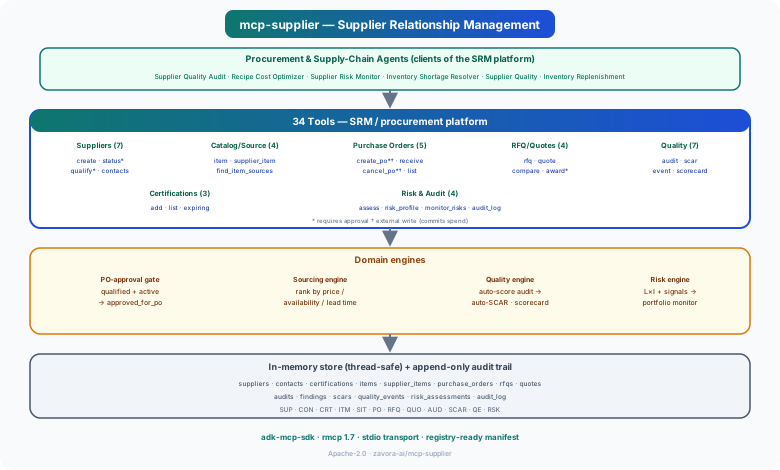
Tool catalog
What can an agent ask Supplier MCP Server to do?
Each tool has a stable name, a human-readable purpose, and a JSON input contract discovered during MCP initialization. Risk classes come from the project’s registry manifest when one is available.
34 named tools
create_supplierRegister a new supplier (prospect, not yet PO-approved)
internal writeget_supplierGet a supplier by id
read onlylist_suppliersList suppliers by category/status
read onlyset_supplier_statusSet supplier lifecycle status (suspend/disqualify revokes PO approval)
internal writeset_qualificationSet qualification status (qualifying approves the supplier for POs)
internal writeadd_contactAdd a contact to a supplier
internal writelist_contactsList a supplier's contacts
read onlyadd_certificationAdd a certification (ISO 9001, IATF 16949, ISO 22000, ...)
internal writelist_certificationsList a supplier's certifications
read onlyexpiring_certificationsCertifications expiring within N days (compliance watchlist)
read onlycreate_itemCreate a catalog item / internal SKU
internal writelist_itemsList catalog items by category
read onlyGovernance
Understand the effect of every tool.
A server connection inherits the authority of its credentials and deployment environment. The declarations below come from this project’s README and MCP registry manifest; your application still decides which tools an agent receives and where approval is required.
16 internal write16 read only2 external write
- High-impact writes are gated (requires_approval): create_po and cancel_po (classed external_write — they commit spend with a supplier), plus set_supplier_status, set_qualification, and…
- The PO gate has teeth — create_po refuses any supplier not approved for POs (wrong status or qualification), so an agent cannot accidentally buy from an unqualified or suspended source.
- Everything is audited — every state change appends to an audit trail (audit_log).
- Reads are read_only — sourcing, scorecards, risk profiles, and watchlists never mutate state.
- Sample data is fictitious.
MCP surface
What the current documentation declares.
MCP can carry tools, resources, prompts, structured results, progress, cancellation, and long-running work. This record highlights the modern protocol features explicitly mentioned by this repository.
The current README concentrates on its tool surface. Check the source and release notes before relying on optional MCP capabilities beyond tool discovery and invocation.
ADK MCP SDKrmcpRegistry manifest
Install and connect
Follow the project’s documented starting point.
Install the server in the environment that owns its credentials and domain access. Add it to your MCP host, verify the discovered tools, and narrow the toolset before giving it to a production agent.
Install
cargo install mcp-supplierADK-Rust connection shape
let toolset = McpToolset::from_stdio(
    "mcp-supplier",
    ["mcp-supplier"],
).await?;

let agent = LlmAgentBuilder::new("agent")
    .tools(toolset.tools().await?)
    .build()?;
Commands and configuration are extracted from the public README. Confirm prerequisites, environment variables, and release-specific options in the official documentation before deployment.
Official documentation
Continue with the project maintainers’ source of truth.
This page provides an approachable map of the server. The repository remains authoritative for exact schemas, prerequisites, configuration, examples, tests, releases, and security updates.
Keep exploring
More in business operations.
Ads MCP ServerA digital advertising platform for ADK-Rust Enterprise sales & marketing agents. 19 MCP tools covering campaigns, ad groups, ads/creatives, budgets and bids, audiences, daily performance metrics with derived KPIs…19 toolsAnalytics MCP ServerGoverned analytics platform for AI agents — metrics, dashboards, funnels, cohorts, anomaly detection, forecasting, and policy enforcement. 28 tools with full audit trail.28 toolsBanking MCP ServerUnified banking MCP server with 15 tools across 3 backends — Plaid (US/Canada/EU), Mono (Africa), and Open Banking (UK/EU PSD2). Accounts, transactions, balances, payments, identity, and statements.15 tools
Source record
Release and repository metadata for this catalog entry.
- Version
- 1.0.0
- License
- Apache-2.0
- Tools
- 34
- Revision
- 255fe8da0810
- Updated
- Jun 9, 2026
Transportsstdio