Provides fraud capabilities through a typed MCP contract.
← MCP server registry
Security & governancePublic source
Fraud MCP Server
A unified fraud layer for ADK-Rust Enterprise agents — combining fraud signals + risk scoring (detection) and case alerts + gated decisions (review) in one server. 19 MCP tools serving both the retail Fraud Review Agent…
What it gives an agent
A purpose-built capability behind one MCP connection.
The server owns its domain logic and publishes a tool contract an MCP client can discover. ADK-Rust can load that contract into an agent, normalize each schema for the chosen model provider, and keep the connection lifecycle outside the agent’s business logic.
Architecture
How Fraud MCP Server fits into an agent system.
The model never needs the implementation details or credentials of the system behind the server. It sees reviewed tool definitions. The MCP client handles discovery and calls, while the server keeps ownership of validation, policy, and communication with its domain system.
01
ADK-Rust agent
Chooses a capability from the reviewed tool catalog.
02
MCP client
Discovers schemas, sends calls, and receives typed content.
03
Fraud MCP Server
Validates the request and owns 19 documented tool contracts.
04
Domain system
Keeps the API, data, credentials, and business rules behind the server.
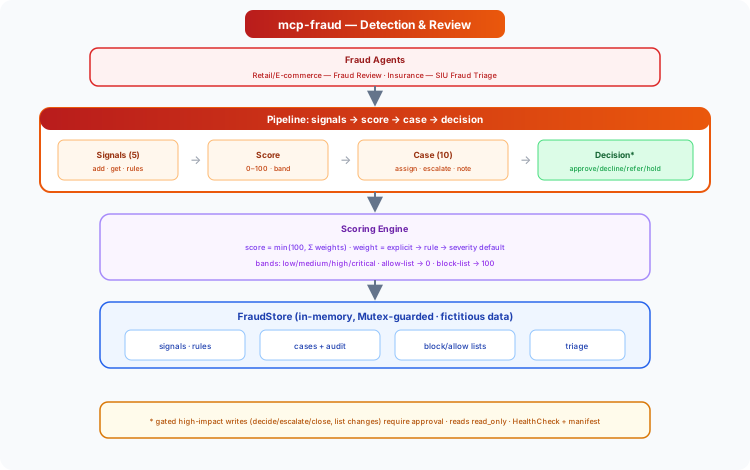
From the project documentation
The server’s published architecture
Tool catalog
What can an agent ask Fraud MCP Server to do?
Each tool has a stable name, a human-readable purpose, and a JSON input contract discovered during MCP initialization. Risk classes come from the project’s registry manifest when one is available.
19 named tools
add_signalRecord a fraud signal/indicator on an entity
internal writeget_signalsList signals recorded for an entity
read onlyscore_entityCompute an entity's aggregate risk score, band, and contributions
read onlyupsert_ruleCreate or update a signal-type risk rule (weight, severity)
internal writelist_rulesList configured risk rules
read onlycreate_caseOpen a fraud review case for an entity (scores at creation)
internal writeget_caseGet a fraud case's full detail
read onlysearch_casesSearch fraud cases (sorted highest-risk first)
read onlyrescore_caseRecompute a case's score from current signals and list status
internal writeassign_caseAssign a fraud case to a reviewer
internal writeescalate_caseEscalate a case (e.g. to SIU)
internal writeadd_noteAdd an investigation note to a case
internal writeGovernance
Understand the effect of every tool.
A server connection inherits the authority of its credentials and deployment environment. The declarations below come from this project’s README and MCP registry manifest; your application still decides which tools an agent receives and where approval is required.
12 internal write7 read only
- Gated high-impact writes — decide_case, escalate_case, close_case, and list changes require approval in production; signal/score reads are read_only.
- Defensible decisions — every case mutation appends to an immutable audit trail.
- Opaque entities — entities are references/tokens (order:…, claim:…, cust:…), not raw PII.
- Integration scaffold — the in-memory store and scoring model are for development; back them with your real signals platform and decision store, and bind actors to authenticated identities…
MCP surface
What the current documentation declares.
MCP can carry tools, resources, prompts, structured results, progress, cancellation, and long-running work. This record highlights the modern protocol features explicitly mentioned by this repository.
The current README concentrates on its tool surface. Check the source and release notes before relying on optional MCP capabilities beyond tool discovery and invocation.
ADK MCP SDKrmcpRegistry manifest
Install and connect
Follow the project’s documented starting point.
Install the server in the environment that owns its credentials and domain access. Add it to your MCP host, verify the discovered tools, and narrow the toolset before giving it to a production agent.
Install
cargo install mcp-fraudADK-Rust connection shape
let toolset = McpToolset::from_stdio(
    "mcp-fraud",
    ["mcp-fraud"],
).await?;

let agent = LlmAgentBuilder::new("agent")
    .tools(toolset.tools().await?)
    .build()?;
Commands and configuration are extracted from the public README. Confirm prerequisites, environment variables, and release-specific options in the official documentation before deployment.
Official documentation
Continue with the project maintainers’ source of truth.
This page provides an approachable map of the server. The repository remains authoritative for exact schemas, prerequisites, configuration, examples, tests, releases, and security updates.
Keep exploring
More in security & governance.
Approval MCP ServerA multi-stage approval workflow engine for ADK-Rust Enterprise legal and media-content agents. 17 MCP tools: configurable workflow templates, stage rules (all-of / any-of / quorum), decisions with delegation and…17 toolsCompliance MCP ServerRegulatory compliance engine for ADK-Rust Enterprise agents. Provides 27 MCP tools covering the full compliance lifecycle — frameworks, policies, controls, audits, findings, evidence collection, risk assessments, gap…27 toolsCredentials Vault MCP ServerScoped, auditable credential access for ADK-Rust Enterprise agents. Provides 8 MCP tools over 5 pluggable vault backends — never exposes raw secrets to LLM context.8 tools
Source record
Release and repository metadata for this catalog entry.
- Version
- 1.0.0
- License
- Apache-2.0
- Tools
- 19
- Revision
- b144ef4232d2
- Updated
- Jun 9, 2026
Transportsstdio