Lists & tasks — task lists by category; tasks with priority, assignee, due date, tags, and a status workflow (todo → blocked → in_progress → done / cancelled).
← MCP server registry
Business operationsPublic source
Task MCP Server
A task & work-management platform for ADK-Rust Enterprise operations agents. 20 MCP tools covering task lists, tasks with a status workflow, priority and due dates, assignment, dependencies (with cycle + blocker…
What it gives an agent
A purpose-built capability behind one MCP connection.
The server owns its domain logic and publishes a tool contract an MCP client can discover. ADK-Rust can load that contract into an agent, normalize each schema for the chosen model provider, and keep the connection lifecycle outside the agent’s business logic.
Dependencies — add_dependency builds a DAG with cycle prevention; a task with unfinished dependencies is Blocked and can't be started/completed. Completing a task unblocks its dependents.
Recurrence — completing a daily/weekly/monthly task spawns the next occurrence (due date advanced, checklist reset).
Checklists & comments — sub-item checklists per task and a comment thread.
Analytics — overdue (past-due open tasks, most overdue first), workload (open tasks per assignee), and list_summary (status mix + completion %).
Architecture
How Task MCP Server fits into an agent system.
The model never needs the implementation details or credentials of the system behind the server. It sees reviewed tool definitions. The MCP client handles discovery and calls, while the server keeps ownership of validation, policy, and communication with its domain system.
01
ADK-Rust agent
Chooses a capability from the reviewed tool catalog.
02
MCP client
Discovers schemas, sends calls, and receives typed content.
03
Task MCP Server
Validates the request and owns 20 documented tool contracts.
04
Domain system
Keeps the API, data, credentials, and business rules behind the server.
From the project documentation
The server’s published architecture
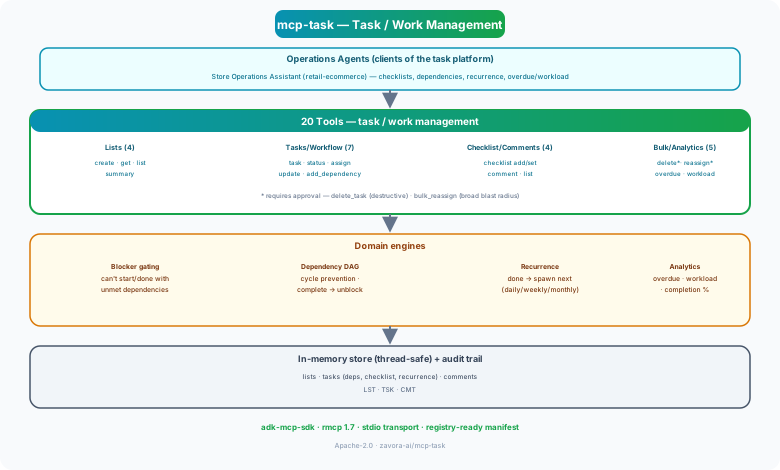
Tool catalog
What can an agent ask Task MCP Server to do?
Each tool has a stable name, a human-readable purpose, and a JSON input contract discovered during MCP initialization. Risk classes come from the project’s registry manifest when one is available.
20 named tools
create_listCreate a task list
internal writeget_listGet a task list
read onlylist_listsList task lists by category
read onlylist_summaryList task counts by status + completion %
read onlycreate_taskCreate a task
internal writeget_taskGet a task by id
read onlylist_tasksList tasks by list/status/assignee
read onlyupdate_taskUpdate title/description/priority/due date
internal writeassign_taskAssign a task to someone
internal writeset_statusSet task status (blocker-gated; spawns recurrence)
internal writeadd_dependencyAdd a dependency (cycle-checked, may block task)
internal writeadd_checklist_itemAdd a checklist item to a task
internal writeGovernance
Understand the effect of every tool.
A server connection inherits the authority of its credentials and deployment environment. The declarations below come from this project’s README and MCP registry manifest; your application still decides which tools an agent receives and where approval is required.
11 internal write9 read only
- Two writes are gated (requires_approval): delete_task (destructive — removes a task and its comments; refused if other tasks depend on it) and bulk_reassign (mass reassignment with broad…
- Workflow integrity — blocker gating prevents starting blocked work; dependency cycles are rejected; delete is refused while dependents exist. Everything is on the audit trail (audit_log).
- Reads are read_only. Sample data is fictitious.
MCP surface
What the current documentation declares.
MCP can carry tools, resources, prompts, structured results, progress, cancellation, and long-running work. This record highlights the modern protocol features explicitly mentioned by this repository.
Completion
Long-running tasks
ADK MCP SDKrmcpRegistry manifest
Install and connect
Follow the project’s documented starting point.
Install the server in the environment that owns its credentials and domain access. Add it to your MCP host, verify the discovered tools, and narrow the toolset before giving it to a production agent.
Install
cargo install mcp-taskADK-Rust connection shape
let toolset = McpToolset::from_stdio(
    "mcp-task",
    ["mcp-task"],
).await?;

let agent = LlmAgentBuilder::new("agent")
    .tools(toolset.tools().await?)
    .build()?;
Commands and configuration are extracted from the public README. Confirm prerequisites, environment variables, and release-specific options in the official documentation before deployment.
Official documentation
Continue with the project maintainers’ source of truth.
This page provides an approachable map of the server. The repository remains authoritative for exact schemas, prerequisites, configuration, examples, tests, releases, and security updates.
Keep exploring
More in business operations.
Ads MCP ServerA digital advertising platform for ADK-Rust Enterprise sales & marketing agents. 19 MCP tools covering campaigns, ad groups, ads/creatives, budgets and bids, audiences, daily performance metrics with derived KPIs…19 toolsAnalytics MCP ServerGoverned analytics platform for AI agents — metrics, dashboards, funnels, cohorts, anomaly detection, forecasting, and policy enforcement. 28 tools with full audit trail.28 toolsBanking MCP ServerUnified banking MCP server with 15 tools across 3 backends — Plaid (US/Canada/EU), Mono (Africa), and Open Banking (UK/EU PSD2). Accounts, transactions, balances, payments, identity, and statements.15 tools
Source record
Release and repository metadata for this catalog entry.
- Version
- 1.0.0
- License
- Apache-2.0
- Tools
- 20
- Revision
- 5da79aa63607
- Updated
- Jun 9, 2026
Transportsstdio